Thursday, April 23, 2009

Artist Category Week 9: Apartment


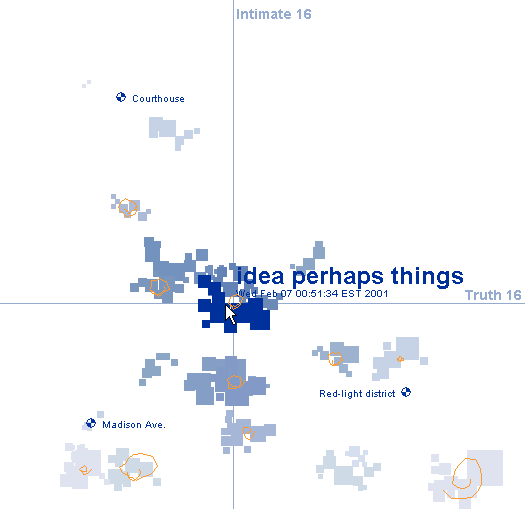
Apartment, Marek Walczak and Martin Wattenberg

Apartment is a program designed by Marek Walczak and Martin Wattenberg that constructs spaces based on the text input from viewers. Visitors are confronted with a blinking cursor and as they begin to type rooms take shape in the form of a two-dimensional plan, similar to a blueprint. The program is able to recognize semantic connections in the visitor's type and then connects them based on theme. Buildings and cities are clustered according to their linguistic relationships.

Apartment seems to be based on a tenant of phenomenological philosophy - that spaces are definied by memory and language and we construct them in our minds not based on dimensions or physical properties but on the memories and ideas that we associate with them. The project almost seems to be an attempt to essential map our minds - to discerne how our different patterns of thought can be translated into a visual component.

The project envisioned by Walczak and Wattenberg can be concieved of in a similar vien to the type of alternative mapping we are exploring in class, but structured in an opposite formation. Rather than going out into an actual environment and distinguishing between different elements that physically define the space, Apartment instead takes our own mental patterns, a purely intellectual pursuit that have no concrete manifestation, and constructs an environment that is definied by their relationships. The element being mapped is then our own trains of thought and their intersticies, and the environment in which these elements are located is a visual representation of our own conciousness.

The ideology behind the project is imaginative and enaging, although its practical implimentation through the programming designed by its creators seems to be limited in constructing a project of the scope imagined. Computers, fortunately, are not yet people, capable of the intricate process of connotation and autonomous linguistic patterns. While Walczak and Wattenberg may have created a comprehensive database of the english language based on definition, it seems impossible to fully express the enormous amount of associations contained in each individual word or to take into account the matter of individual interpretation. The program is tremendous for its potential to create a primitive landscape of the mental realm, but at this current stage I do not think there is the technology available to fully map the mind. I truely hope that day never is realized either, because I dread the thought that all the enormous power of the human imagination can be reduced down to a code that can be read through a computer.

Artist Category Week 8: Feed


Feed (detail), Mark Napier, 2001

Feed is a system created by Mark Napier that "unravels the web". It reads the information - HTML and images - of a specific URL and reduces them into a stream of text and images. The feed is fed to nine displays that chart, graph and plot the data. Similar to many of Napier's other online projects, including The Shredder, Feed is designed to create an aesthetic visual experience that is based on a purely random computation of raw data.

Napier's work addresses the issues of "authorship" and "ownership" that are intrinsically redefined when art is created through a digital medium. In projects like Feed that incorporate an essential degree of interaction from viewers in order to operate (inputing a URL), the question is raised over who has claim to the visual product - Is the engineer who designed the code that randomizes the image the artist? Is the visitor who defines the URL to that is "fed" the constructor of the image? Is the person who created the webpage that is being randomized the author?

Can there be an author at all of media on the web? Feed highlights the fact that everything online is composed of data - of binary codes that are meaningless unless they are read by a computer. Despite the fact that individuals may organize these codes into a variety of images and text, each pixel can be reduced down to a single number. Can anyone really claim property over a series of 1s and 0s? If so - to what extent? How much information must be involved for a piece of data to be considered unique?

The issue of randomization in producing computer-based graphical images also highlights the problem of claiming authorship. In design programs such as Photoshop and Illustrator, many of the tools that can be utilized function according to a computer-based randomization system. If artists utilize these tools in the creation of images, can the products they produce really be considered an expression of their own design or are they credited only to the computer's inner operating system. Again, there also is the question of the extent to which this applied, and when can we say a work is ours and when is it just a random orientation of pixels created by a program?

This issues of authorship are relevant to me as a producer of online media and as a victim of creative theft of online media. The extent to which someone who produces a digital graphic - or even creates a unique HTML code - can lay legal claim over their work still seems to lie in a gray zone.

Tuesday, March 31, 2009

Artist Category Week 7: Deep Space


Deep Space, ARS Electronica

Deep Space is a current exhibit at the ARS Electronica building. The technological heart of Deep Space consists of eight 1080p HD- and Active Stereo-capable Barco Galaxy NH12 projectors. The images are projected onto mammoth 16x9-meter displays mounted on the wall as well as in the floor. A great vantage-point view and a dizzying shift of perspective is available from the Deep Space Platform set up at an altitude of about five meters. The possibilities for display in the space are endless and currently feature a wide variety of artist works featuring innovative graphical techniques and create storytelling mediums, recreations of architectural and art historical spaces, and images shot by top of the line cameras.

Deep Space, for me, represents the irreversible cohesion between science and art that has emerge through the development of modern technology. The resources available today to visual artists allow them to create works that break the two dimensional, sight-dominated format of traditional artists works that it is hard to image them as working within the same discourse anymore. The space created in Deep Space submerge visitors in an all-encompasing experience of sight and sound, and most importantly: space. The technology seems to be similar to that of Imax, in that you can surround your viewers with visual image and sound in order to more fully engulf them in a viewing experience. However, Deep Space creates an opportunity to utilize this technology for mediums beyond that of film, creating an interactive, overwhelming new artistic medium.

While much of what is projected in the room would traditionally be considered the work of science - intense, high resolution images of nature, delicate recostructions of historical sites, explorations into macro- and micro-visions - the venue allows for this work to presented as a kind of art. The presentation of this imformation in the space is not for the sole purpose of imparting scientific knowledge on viewers: the creators designed the space so that viewers will be engaged in an experience. This is the overlap I see emerging between art and science through the use of technology: science provides the format and mechanisms through which this information can be presented, as well as providing more advanced ways of imaging nature, while the actual conveyance of information is conducting in increasingly superfluous and creative ways that move beyond pure information transfer.

Friday, March 13, 2009

Alphabet Project: Critique Response

After discussing my ideas in class, I think I am going to latch onto the idea of using the symbology of B as a blueprint for the compositional basis for my image. M's assosiation with questioned identity will be the unifiying message of the poster. C's relation to the staff sling, and movement will form mostly a navigational design element in the poster, though I may try to integrate it visually with the association of "leaving the house" through the use of the blueprint.

Now I just need to make Illustrator bend to my will to graphically create what I can see in my head!

Wednesday, March 11, 2009

Journey Project: Critique Response

One of the most intriguing things I found in looking comparatively at the class's interpretations of the Journey project was the way in which certain students tried to create a visual landscape that the viewer was engaged with and moved through, while others went for a more intellectually focused journey that was linked by thoughts.

My conception of the journey project was very much centered around a physical journey that viewers could follow through virtually. This was much more pronounced in the "real" side of my journey as opposed to the "imagined" journey, but the use of arrows and directional symbols on almost every page of the project were a reflection of my visualization of actually traveling through this digital space. Viewers were obviously not treading the real path I took when gathering photos for the project, but I tried to provide a wide, encompassing view of what would actually be see in each step of the journey. The act of clicking on icons in order to reach the next page is not the same as actually walking through an environment, but the movement of clicking the mouse in order to be presented with a new landscape was intended to mimic the act of travel (as much as that can be conveyed through a computer screen).

I had not concieved of the project in this way, but Stephanie's page was a good example of moving through a space based on thought processes. The locations she presented were physical places that did require travel to reach, but the connection between them was more of a mental connection rather than geographical proximity. To a certain degree, this is the approach I took for my imagined journey - going from one place or image to another based soley on trains of thought. Though I did not verbally state it on the page, my imagined journey was related to the journey you go through when you open a book and engaged with a written process. You do not physically leave the space you exist in, but your mind is able to jump from one environment to another because of mental processes and associations.

One of the other major disctinctions I saw in the way this project was approached was the kind of links students provided in order to guide users through a page and onto new pages. Certain projects, including my own, were based on visual links that required some background knowledge of common symbols and associations in order to understand the kind of movement that they would take you through. The other approach used by most of the class was a text based one that either explicitly stated where you were going, or provided a hint. Both methods could produce similar effects in how the pages were interacted with, but they again reflected a difference between a physical journey and a mental journey. Because I was looking to recreate the experience of physically moving through a space, I used mostly icons that were familiar on road signs or symbols such as footsteps that are easily recognizable for determining how to move. This was a reflection of the idea that when walking, you are generally not provided with a narrator explaining the places you are going - there are common symbols and objects that people will recognize and make their own associations with. As much as the project was my own journey and structed so that visitors will follow the links I have provided them with, I wanted users to be able to interpret how this journey would feel and be experienced by themselves as individual without any written guideance for how it should be viewed.

Sunday, March 8, 2009

Letter Project Take 2

In considering the history and imagery related to the letters of my initials, I have some preliminary plans on how to construct a poster based on them.

When I imagine the idea of a poster, it is often to advertise something or introduce an idea and they do not often serve a purely visual and none intellectual function. Due to this, I have been playing around with the idea of creating a slogan to use as the basis for my poster. I am very intrigued with the concept of questioned identity that is proposed by the letter M, particularly because the letters I am using are based on my own name and identity. I don't have a concrete slogan just yet, but the one I am currently bouncing around is "Who aM I? What Can I Be?" The message is not as important as much the fact that it is a question that features the letters I am dealing with. These letters will play a prominent visual role in my poster. I plan to incorporate some evolutionary visual element with each of my initials that will feature many of the symbols and letters that led to their current form. I have been collecting a visual history of each letter and will use these mainly as a compositional element rather than a conceptual one.


I also plan to use imagery of blueprints as a basic layout for my poster. The letter B's main ideological history relates to the image of floorplans. Floorplans are also a way of attempting to identify and construct a space, much as my poster will be attempting to identify and construct an indentity for these letters.


In regards to C, I am latching onto the idea of a boomerang. The letter has a history related to both camels as well as sling staffs, which are similar to boomerangs. I would like to use the trajectory and pathway of the boomerang as a visual path or guide through my poster. I will also likely include the imagery of water, in the form of ripples, that comes from the letter M as a compositional element in the poster.


Artist Category Week 6: Floating Points 6


Floating Points 6: Games of Culture/Art of Games, 2009

Floating Points 6 is a film screening, symposium and workshops with Asi Burak, Anita Fontaine, Jesper Juul, Friedrich Kirschner, Marcin Ramocki, Jason Rohrer, Adriana de Souza Silva, Mushon Zer-Aviv that will take place March 20-21. The symposium is designed to address how the popularity of video games has affected almost every aspect of our lives in the digital age, including art. Issues that will be addressed are how games provide inspiration but also often function as advertisements or for consumer engagement and employee productivity. How deeply ingrained in our society have video games become?

Video games have a narrative quality that has altered how we percieve and engage with stories in a way that is far beyond any other medium on the market. Films served in a similar revolutionary way when they allowed viewers to see actors in a more intimate way than ever before through a feat of technology that was unprecedented. Video games have also introduced a new element to storytelling that was never pursued to such a degree before: interactivity. The influence of video games on culture, youth, and particularly in how they alter the moral functions of users is a constant issue of debate. What is also of interest is how they have altered how art that uses digital elements is constructed and imagined on the part of the artist and the viewer.

This symposium seems particularly relevant in light of the digital artists we have been investigating. Almost every New Media artist has incorportated some interactive aspect into their work that is either conciously or unconciously influenced by the advent of video games and would likely not have been concieved of if this new medium had not taken hold of popular culture in the way that it has. How far can we go in labeling a video game as a work of art in the same way that a movie or a novel is considered in this category? It is interesting to see how video games have altered how films and written works are now considered. Also, will these older forms of technology become obsolete in the future as everything is converted into digital format? This seems particularly prevelant with the new versions of blackberries and Ipods that advertise reading books and watching movies on your phone. It is almost terrifying to think of the day that the book is no longer in use, although it may be fast approaching due to the convience of new technology.